
Greater Ani is not your regular cuckoo. Rather than dump its eggs in the nests of other species it builds its own and raises its young alongside other breeding Anis. The eggs bump into each other with quite some force as parent birds turn them during incubation. Now, researchers have shown that Anis have evolved eggs with the added protection of an uncommon mineral that keeps the eggs from cracking under pressure.
Vaterite, a form of calcium carbonate, sits on the eggshell of some birds in tiny spheres of varying size. It is less stable and abundant than calcite – another form of calcium carbonate that primarily constitutes the shell. Vaterite gives freshly laid Ani eggs their white chalky appearance. As incubation progresses, it gets scratched, exposing patches of the pigmented calcite underneath. When scientists studying nesting Greater Anis (Crotophaga major) in the Panama Canal noticed this change in the egg surface they decided to look deep into it.
Read the rest of the story here at Chemistry World.
Photo credit: Christina Riehl
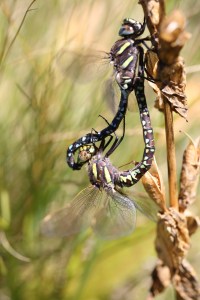 Once a female dragonfly has mated, all she is interested in doing is laying eggs and getting on with her life. So, when stalked by an unwelcome lover (or two), she crashes to the ground and plays dead. When the duped males eventually leave, the female flies off. The behavior was reported recently in the journal Ecology.
 Richa Malhotra