
Some owls are so small, they are known as owlets. The forest owlet, a species unique to India, is one such owl. It was discovered in 1872 when F. R. Blewitt collected the first specimen of the bird in present-day Chhattisgarh. Six more specimens of the “Blewitt’s Owl” were collected until 1884 from Maharashtra and Odisha by two other collectors. Then, more than a century went by without a single legitimate record of the bird.
Alleged forest owlet records that came after 1884 — eggs, photographs, skins, or sightings — didn’t really belong to the forest owlet. One record, dated 1914, was indeed of the forest owlet but it was fraudulent — its label had been fabricated and the specimen tampered with. A collector had stolen one of the 19th-century specimens from the Natural History Museum in Tring, UK, and labeled it with a made-up collection date and location. This led to search efforts in the wrong location. With no sightings in this and other places, many believed that the bird had gone extinct.
Had it though, gone extinct? Find out in my story for The Swaddle.
Image: Farah Ishtiaq holds a forest owlet while studying the species in the late ’90s (Courtesy of Ishtiaq)





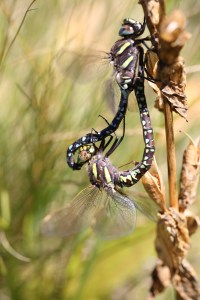 Once a female dragonfly has mated, all she is interested in doing is laying eggs and getting on with her life. So, when stalked by an unwelcome lover (or two), she crashes to the ground and plays dead. When the duped males eventually leave, the female flies off. The behavior was reported recently in the journal Ecology.
 Richa Malhotra